
Functional Safety expertise supporting compliant, reliable residential and commercial appliances
At Intertek, we help manufacturers bring safe and compliant residential and commercial appliances and equipment to market. Our Functional Safety team provides practical guidance tailored to these products, helping ensure designs meet Functional Safety requirements and perform reliably in real-world conditions.
We support you at every stage of development by performing design reviews, conducting hardware and software evaluations, assessing safety-related control functions, and carrying out fault analyses. With extensive experience across various industries, including appliances, heating and cooling systems, cooking equipment, and beyond, we combine technical expertise with hands-on testing to help our clients enhance product safety, reduce risk, and achieve efficient certification for global market access. Common application standards include*:
- UL 60335-1 – Household and Similar Appliances, including various part 2 standards (i.e. UL 60335-2-40)
- UL 174 – Household Electric Storage Tank Water Heaters
- UL 499 – Electric Heating Appliances
- UL 1563 – Electric Spas, Equipment Assemblies, and Associated Equipment
- UL 858 – Household Electric Ranges
- UL 795 – Commercial-Industrial Gas Heating Equipment
- UL 197 – Commercial Electric Cooking Appliances
- UL 507 – Electric Fans
- UL 1278 – Movable and Wall- or Ceiling-Hung Electric Room Heaters
- UL 2157 – Electric Clothes Washing Machines and Extractors
- UL 1995 – Heating and Cooling Equipment
- UL 873 – Temperature-Indicating and Regulating Equipment (note: withdraw/replaced by UL 60730-1)
- UL 353 – Safety-Limit Controls
- UL 325 – Door, Drapery, Gate, Louver, and Window Operators and Systems
- UL 8750 – Light Emitting Diode (LED) Equipment for Use in Lighting Products
- UL 924 – Emergency Lighting and Power Equipment
- Various ANSI Gas Appliance related standards (i.e. ANSI Z21.10.1, ANSI Z21.20
*IEC/EN and CSA Harmonized standards are implied unless stated specifically.
These product standards often reference safety-related control requirements and may require evaluation of programmable electronics, embedded software, and safety-critical control functions.
Functional Safety in Residential and Commercial Products
Functional Safety ensures appliances continue to operate safely during normal operation and when faults occur within electrical, electronic, or programmable control systems. In modern residential and commercial equipment, safety-related functions are often managed by microcontrollers, sensors, and embedded software responsible for controlling temperature, pressure, gas flow, motor operation, and other critical processes.
A structured Functional Safety approach helps manufacturers identify potential hazards and implement design measures that allow appliances to detect faults, identify abnormal operating conditions, and transition the system to a predefined safe state when necessary. This helps reduce risks associated with hardware failures, firmware defects, control-system malfunctions, and unintended user interaction.
For manufacturers of residential and commercial appliances, implementing Functional Safety principles improves product reliability, supports compliance with certification requirements, and enhances confidence that safety-critical functions will perform as intended throughout the product lifecycle. Functional Safety concepts are commonly applied to safety-related control systems used in residential and commercial appliances. Typical examples include:
- Over-Temperature Protection in Heating Appliances
Electric heaters, ovens, ranges, and water heaters often rely on electronic temperature sensors and control systems to prevent overheating. Functional Safety evaluation verifies the ability of the control system to enforce the declared temperature limits to prevent hazardous situations.
- Gas Control in Gas-Fired Appliances
Gas-fired appliances such as boilers, furnaces, and water heaters rely on safety-related controls to regulate gas flow and verify ignition conditions. Functional Safety analysis evaluation ensures proper operation of normal critical functions and ensures gas valves close safely if abnormal combustion conditions, ignition failures, or control system faults occur.
- Motor and Fan Control Systems
Appliances such as HVAC equipment, ventilation systems, and commercial heating equipment rely on motors and fans to maintain proper airflow and cooling. Functional Safety assessments verify that control systems detect stalled motors, sensor failures, or abnormal operating conditions that could lead to overheating or unsafe operation of the controller motor or appliance.
These safety-related control systems are evaluated using the applicable functional safety standards referenced within the end-use product safety standards. These evaluations help verify that safety functions respond appropriately to hardware faults, software errors, and abnormal operating conditions. Intertek provides Functional Safety expertise for a wide range of residential and commercial appliances, including:
- HVAC systems and heat pumps
- Refrigeration equipment and commercial cooling systems
- Electric and gas water heaters
- Electric ranges and cooking appliances
- Electric heaters and heating equipment
- Spas, hot tubs, and pool equipment
- Commercial gas-fired heating systems
- Smart appliances with embedded software and connected controls
Technical Expertise Across Global Standards
Intertek Functional Safety Engineers work with you to identify the correct Functional Safety framework for your product’s architecture, application, and regulatory pathway. We support North American and International Functional Safety standards, including:
- IEC 61508 — Functional safety of electrical/electronic/programmable electronic systems
- UL 1998 — Software in Programmable Components
- UL 991 — Tests for safety‑related controls employing solid‑state devices
- IEC/UL/CSA 60730, Annex H — Automatic Electrical Controls
- UL 5500 — Remote Software Updates
- CSA C22.2 No. 0.8 — Safety functions incorporating electronic technology
How We Support Product Development and Certification
Our Functional Safety services integrate seamlessly with your product‑development lifecycle:
- Hazard and Risk Assessment reviews
- Hardware evaluations against Functional Safety and application‑specific requirements.
- Firmware and software assessments verify compliance with lifecycle, design, and verification/validation requirements.
- Identification and development of product specific test programs to satisfy the respective Functional Safety standard and application standard.
- Certification deliverables:
- Formal letter reports to support application‑standard evaluations to show evidence of a Functional Safety Evaluation
- ETL Recognition
- IECEE CB Scheme or Informative Test Reports to support CE self-declaration.
- Preliminary Design Reviews from Intertek’s certification engineers for early‑stage information/ guidance, or design‑support services through Intertek Assurance for deeper engineering assistance.
- Functional Safety Mark (FS Mark)
Why Choose Intertek
- Specialized Functional Safety expertise with certification engineers and consultants experienced in a wide array of household and commercial products and regulatory pathways.
- Functional Safety staff collaborates with cross functional teams within Intertek’s organization, enabling faster evaluations, clearer communication, and reduced project delays.
- Confidence and compliance assurance, ensuring your product meets all relevant Functional Safety expectations and is prepared for either the North American or global market access.
Related Links
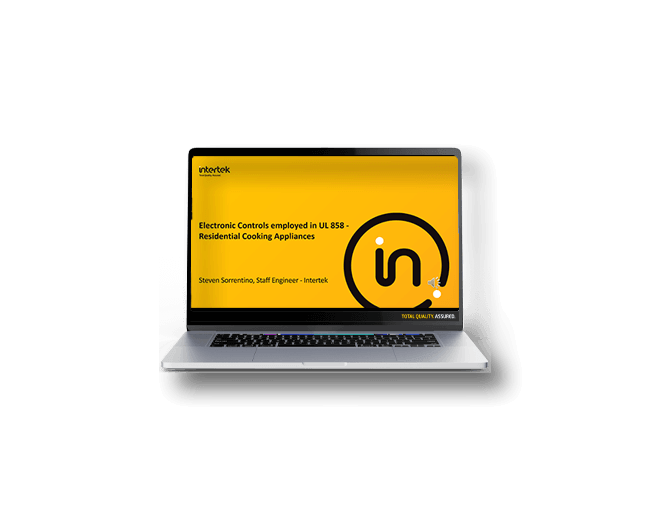
Functional Safety – Electronic Controls Use In Residential Cooking Appliances | Webinar
This on demand webinar explores the critical role of electronic controls in modern residential cooking appliances, with a focus on UL 858 and UL 60730 requirements and Class B safety critical functions.
You may be interested in...

Household Appliances Testing Services
Intertek can verify the safety, quality and overall value of Household Appliances and Consumer Electronics, helping to distinguish your product to retailers.
Commercial Appliances Services
Intertek is a complete testing solution partner for virtually any Commercial Appliance including Commercial Refrigeration & Freezers, Food Service Equipment, and more.
Knowledge Center
Transitioning Products and Certification to UL 60335-2-89
NSF 456 Vaccine Storage Fact Sheet
Germicidal Efficacy Testing: Appliance Considerations
Germicidal Products: Safety, Performance, and Efficacy
IEC 62368-1 Standard Compliance Guide White Paper
Product Listing & Marking Strategies White Paper
Household Dishwasher Test Method EN 50242:2016 Fact Sheet
Gas Appliance Regulations: Guidance for Implementation of GAR vs. GAD White Paper
Flammable Refrigerants: Comprehensive Assurance Fact Sheet
Ceiling Fan Energy Efficiency: Compliance with DOE Rule 10 CFR Part 430
G Marking For Low-Voltage Electrical Products in the Middle East White Paper
Related Links
- Why Meeting Safety Standards can Still Result in Recalls
- Reese's Law – ANSI/UL 4200A-2023
- Product Directories
- Public Notices & Product Safety Alerts
- Smart Grid Services
- Transitioning Products and Certification to UL 60335-2-89
- IEC 60335-1 Edition 6 Fact Sheet
- Germicidal Efficacy Testing: Appliance Considerations
- NSF 456 Vaccine Storage Fact Sheet
- Cybersecurity for Consumer Products
- Intertek Performance Gateway
