Conspicuously Inconspicuous: Air Barrier Field Installation Issues
30 Jan 2026
Hidden Sequencing and Penetration Issues that Affect Airtightness
Air barriers do their most important work when no one can see them. Once the air barrier is covered with continuous insulation and exterior finishes, any air barrier field installation detail issues are hidden from view until a whole-building airtightness test proves the air barrier ineffective and, somehow, not the expected protection against destructive air leakage.
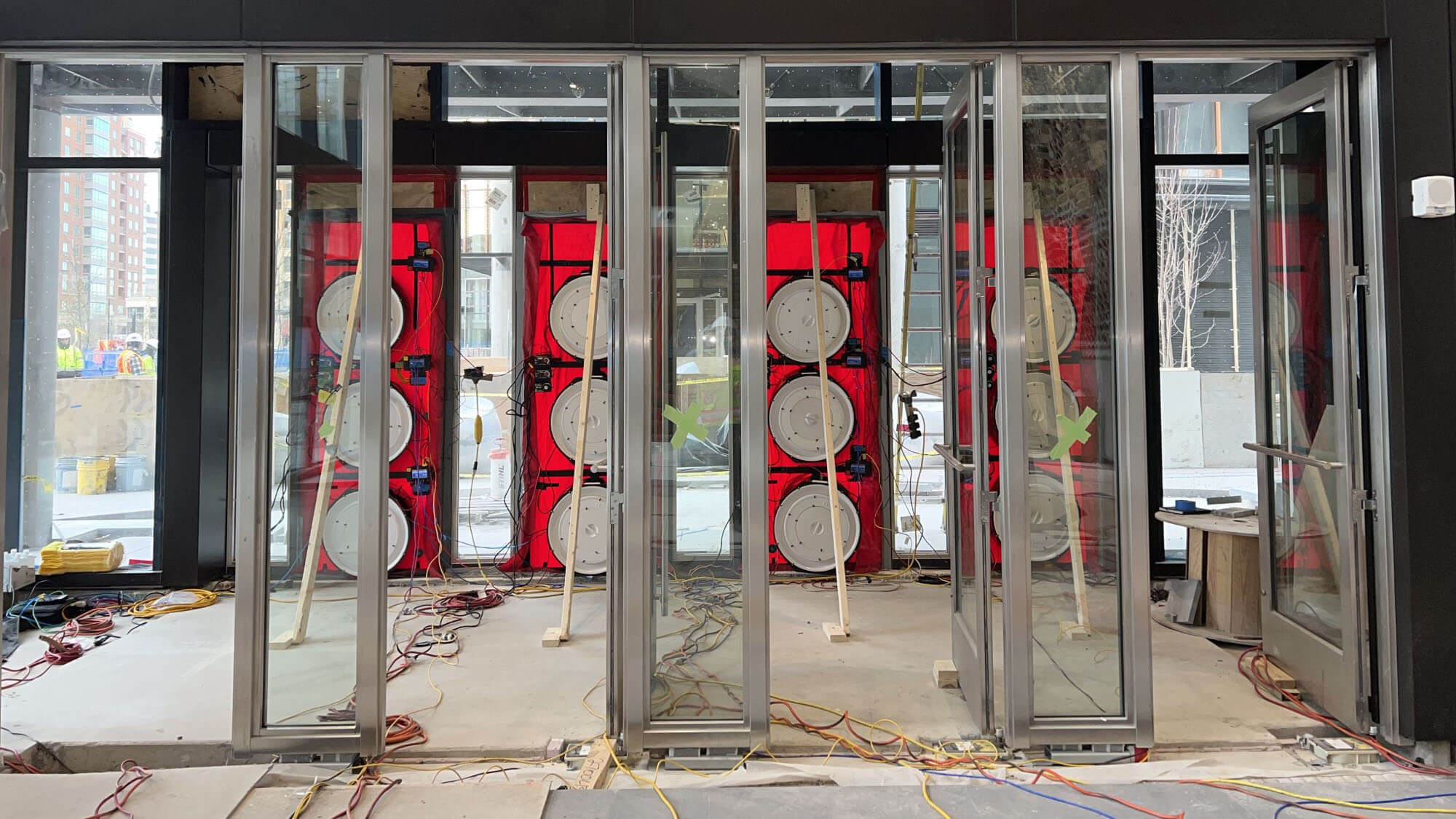
In new construction, air barrier installation has become commonplace for finding detailing issues and concerns in airtightness through field testing of all kinds — whole-building and detail-localized; code-compliance and owner-driven. While there are several air barrier field installation issues to be watchful for, the two of particular focus are improper sequencing and detailing at transitions, and penetrations through air barriers after installation.
These two field installation issues are universal regardless of the building exterior finish. General contractors and air barrier installers repeatedly endure these two pain points in buildings with exterior finishes from masonry to metal wall panel.
Improper Sequencing and Detailing at Transitions
Improper sequencing and detailing at transitions apply to every exterior system, but they are highly impactful to the air barrier installation and, in turn, to the building performance. Sequencing the installation of exterior systems from a general contractor’s point of view is an everyday event — the overarching basis of their work and the focus of one or more staff at the site. Sequencing changes frequently when a subcontractor’s schedule or staffing does not align with the original order of work.
From the building enclosure consultant’s point of view, the most problematic air barrier installation sequencing and detailing transition is the roof-to-wall detail. Whole building airtightness testing, building enclosure forensics and potential litigation prove the roof-to-wall transition is the biggest issue in poor building performance.
Considering there are no fewer than three different trades that affect air barrier continuity at the roof-to-wall transition, coordinating those trades at the roof edge in the order required by the drawings is like aiming at a moving target.
An example of out-of-sequence detailing at the roof edge occurs when the steel stud and spray foam were installed on the wall before the self-adhered air barrier detail membrane was installed on the fluid-applied air barrier and transitioned onto the roof-edge wood blocking. On an adjacent exterior elevation, the clay brick masonry was installed before the self‑adhered air barrier detail membrane was installed at this transition, requiring the masonry to be removed to install the membrane. Out-of-sequence detailing at the roof edge is costly and time consuming when those three different trades are required to rework the detail before construction can move further.
Penetrations Through Air Barriers After Installation
Penetrations through air barriers after installation are common with conduit, plumbing, and metal wall panel clips. While conduit and plumbing penetrations installed after the air barrier can be avoided with proper sequencing, metal wall panel clips installed after the air barrier cannot. Airtight installation of metal wall panel clips requires additional detailing attention.
Although metal panel wall clips may be labeled or sold as self-sealing, the approach during installation is to install a bead of air barrier sealant at the clip fastener penetrations as an added step to seal the fastener location. Another approach to address the clip fastener penetration begins in the design phase by sealing the fastener penetrations from the interior side of the sheathing with spray foam insulation or other air barrier material in the stud cavity. This again requires sequencing the metal wall panel clips before installing the interior side material.
Regardless of the approach to sealing the metal wall panel clip fastener penetrations they can be tested with a small, depressurized chamber and leak detection liquid applied at the clip attachment. Considering the fastening patterns and the number of clips required, any extra insurance by sealing the fastener well worth the time and expense to avoid additional air leakage caused by fasteners penetrating the air barrier after installation.
Why These Issues are Often Missed
The two air barrier field installation issues, sequencing and penetrations, are easily covered by the successive layers of the exterior wall system, causing missed opportunities to pursue the best air barrier installation outcome or to repair faulty details before field testing the whole building or specific details for airtightness.
Sequencing, particularly at the roof-to-wall transition, is critical for maintaining air barrier continuity and eliminating rework during construction. Penetrations, such as metal wall panel clips, need to be addressed in the finer installation detailing during construction or in the wall section detail during design.
Achieving Effective Air Barrier Performance
Attaining proper sequencing and sealed penetrations in the air barrier field installation requires a thorough understanding of both the construction and design phases to achieve the necessary air barrier continuity for building airtightness and, ultimately, effective building performance.

You may be interested in...
Whole-Building Air Barrier, Leakage Testing
With Intertek’s Whole Building Air Barrier Solutions, building owners can be assured that their building enclosure is airtight, meeting required performance targets required by code and high-performance building standards.